St Ursula's Church
Berne, Switzerland
A Church of the Anglican Communion, welcoming all who seek the Lord Jesus Christ
|
| St Ursula's Church
| ||||||||||||||||||
| News | Contacts | Who We Are | Where We Are | Magazine | Pictures | Charities | Rotas | Weddings | Site Map | ||||||||||
| 1850-1860 | James Frederick Lateward |
| 1847-1860 | William Thomas Postles Tymperley |
| 1861-1863 | George William Mackenzie |
| 1861-1880 | Various chaplains under the patronage of the CCCS |
| 1881-1886 | Robert Skinner |
| 1887 | Joseph Bernard Smith |
| 1888 | Arthur Anglin Mitchell |
| 1889-1890 | Bertram George Durrad |
| 1890-1893 | Thomas Carter Stanley |
| 1893-1894 | William Henry Boyne Bunting |
| 1894-1896 | Alfred Swainson |
| 1897-1903 | James Richard Dutton Thompson |
| 1903-1905 | Herbert MacDonald |
| 1905-1907 | Gilbert Holme Sissons |
| 1907-1912 | W Richard Henry Pring |
| 1913-1916 | Harcourt Robert Henry Lightburne |
| 1921-1935 | Alexander Bassell Winter |
| 1937 | John Knight Lomax |
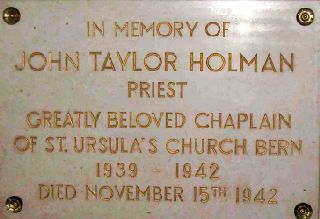
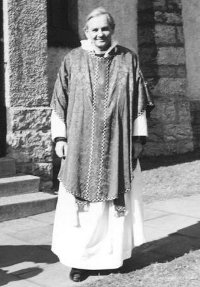
| 1939-1942 | John Taylor Holman |
| 1942-1945 | J George Moore |
| 1946-1952 | Markus Matthaeus Vischer |
| 1952-1954 | William Rowland Jones |
| 1954-1968 | Reginald Bernard Gray |
| 1968-1976 | Sidney John Baggott |
| 1976-1989 | Peter John Hawker |
| 1990-2001 | David Colin Wotherspoon |
| 2001-2007 | Richard Lawrence Pamplin |
| 2008-2016 | Peter Maxwell Potter |
| 2017-2018 | Stephen Stuckes |
| from 2019 | Helen Jane Marshall |
 Canon Sidney John Baggott
From 1937 until 1947 he served in Nigeria. He returned to Europe, and was appointed chaplain in Leysin in 1947. With interruptions at Davos from 1948 to 1950 and in Marylebone in 1951 and 1952, he served as the last full-time chaplain of Leysin, serving Villars and Montana as well, until 1968, when he moved to Berne.
He was appointed Rural Dean of Switzerland in 1966, and Honorary Canon of Malta Cathedral in 1972.
Crockford's Directory for 1899 lists him as chaplain at Rummelsburg and Berne in 1889 and 1890.
In 1891 he returned to Wem, in Shropshire, and after 1893, served at Chadsholme, and Harpenden in the Home Counties.
The requirement for the post stated that the new chaplain "should be a gentleman with a minimum of tact, and should know how to behave in diplomatic circles." Immediately after his arrival, the church hall and house were built, being completed in 1956. During his early years in Berne, Barney Gray also served Basle fortnightly. (There was a suggestion that the CCCS chaplaincy in Basle and the SPG chaplaincy in Berne should be merged, but this never took place. Instead, Basle was set up as a permanent chaplaincy in 1955.)
He retired in 1968, and stayed on to assist his successor, Sidney Baggott. He finally left Berne, to full retirement, in 1974. He died in a Worthing nursing home on 26 September 1986. His wife, Pat, had died in Berne in the 1960's.
After the war, he served in Algiers and Hong Kong (where he was registrar to the University), before becoming chaplain to the British Legation in Peking from 1923 to 1933. He was awarded an OBE in 1926. John Holman was appointed chaplain in Frankfurt in 1934, also covering Stuttgart and Baden.
He moved to Berne in as war started to threaten in 1939. His first service at St Ursula's was on 30 April. In 1940 he reported: The British community is so small as to be non-existent, except for the Legation and Consular staffs which have greatly increased during the war. Apart from them, not a single purely British family in Berne. There are many Anglo-Swiss. Sunday morning attendance autumn 1939: 40, winter: 25.
He fell ill suddenly at the end of 1942. He took the service on 1 November, but was unable to officiate the following Sunday. He died on 15 November 1942 and was buried in the English Cemetery in Berne. His memorial plaque is in St Ursula's.
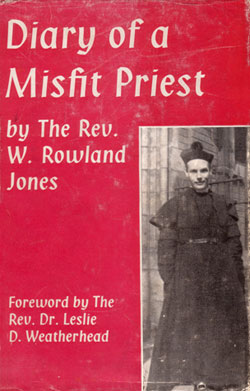
His leanings towards High Church Anglicanism led him to seek ordination in the Church of England. He was made deacon at Durham by Bishop Hensley Henson on 19 December 1920, and priested the following year.
He served in Durham, Hampstead, Highgate and Mayfair. He knew Ramsay MacDonald, and an interview with the Prime Minister's patronage secretary led to his becoming vicar of St Hilda's, Audenshaw, where he served from 1930 until 1952.
He was awarded a doctorate, and published several books on psychology between 1941 and 1948.
His Anglo-Catholic views met with some opposition in Audenshaw, although he claimed to be an "Evangelical Catholic". In 1952, the Bishop of Manchester recommended his appointment as chaplain at Berne. On his arrival, he was immediately plunged into the ambitious plans of the Building Committee, consisting of the businessman, Theodor Meyer, the British Consul, Frank Dixon, and the brewery proprietor, Hamish Munro, for the building of a church hall and house. There seem to have been various personality conflicts, particularly with the diplomatic circles within the congregation. His refusal to buy a dress suit led to his exclusion from the Coronation celebrations at the British Embassy in 1953.
As "president of the British Psychological Society" he gave a course of twelve lectures in 1953 on The Mechanism of Mind, and a further six beginning on 4 February 1954 at the English Institute.
He was later asked to submit his sermons to the British Embassy in writing for vetting, and eventually had to leave shortly before Easter in 1954. The Good Friday and Easter services that year were taken by Bishop A Stephen Neill, at that time with the World Council of Churches in Geneva.
In 1960, his Diary of a Misfit Priest was published by Allen and Unwin.
A square with radiating streets had been envisaged by the original plan for the Kirchenfeld development in 1881. The square itself was only built in 1903, though, and was named Jubiläumsplatz by resolution of the city council on 17 February 1904.
Theodor Kocher became an assistant in the surgical clinic in Berne in 1866. From 1872 to 1911, he was professor of surgery. He was also a pioneer in the surgery of the stomach, the gall-bladder, the joints, the brain, the uterus and the spinal chord.
However, he is most particularly known for pioneering an operation for removing the thyroid gland as a treatment for goitre. His treatment, which involved delicate and careful surgery, reduced the mortality to a very low figure. As a result of this and his other innovations, he received the Nobel Prize for Medicine in 1909.
He was one of those addressing the International Congress of Arts and Science in St Louis in 1904, and it was probably through this that he came into contact with Mrs Castleman.
However, he felt called to the ministry, and went up to Selwyn College, Cambridge in 1904, graduating in 1907 and receiving his M.A. in 1911. He was made deacon in 1909 and priested the next year. His first curacy was at St Anne's, Aigburth, from which he resigned in 1911, "not being able to stand the 'Aigburth use' any longer." He served a further curacy at St Margaret's, Anfield.
After five Sundays at St Faith's, Great Crosby, in May 1913, Harcourt Lightburne came to Berne on 1 October of that year on what was at first a six-month appointment. In the spring of 1914, the appointment was made permanent. He lodged at the Pension Herter, Kramgasse 5.
One of his first tasks was to put the church's finances on a better footing. He inaugurated a subscription scheme. He also threw himself enthusiastically into church work, initiating children's services and a catechism class after the Sunday morning service, and a Bible study during Advent. It was in Lent 1914, too, that he began holding daily services, and a mid-week Communion service. He also wrote a weekly column with gossip from Berne for The Italian Lakes and Swiss Chronicle under the pseudonyn Harcourt Harcourtson.
The outbreak of war meant that much of his correspondence with England had to be by telegram.
He became very fond of Switzerland, and while in Berne, he met and became engaged to Nora Münch, the daughter of a Swiss architect and an English parson's daughter. In February 1916, he wrote to his congregation: "I am returning shortly to England: considerations of a personal nature making it now necessary for me to resume work there promising provision for the future." Presumably his engagement to Nora made it necessary to find a better-paid post. However, he also alludes to recently experiencing "certain other great and bitter disappointments."
From 1917 to 1919, he was a temporary chaplain in the Royal Navy, serving in South African waters. In 1920 he moved to Canterbury, where he married Nora Münch on 11 February at St George's Church, where he was in charge while the Rector reorganized the work of the Church of England Temperance Society at its head office. By doing wihout a maid, the couple were able to visit Switzerland annually until their four children were born. After a further assistant curacy at St Martins and St Paul's, Canterbury, lasting until 1924, Harcourt served the rest of his ministry in Hawkhurst, Upchurch and elsewhere in the Canterbury diocese.
(A 2003 magazine article also depicts Harcourt's life in Berne.)
In 1861, the Colonial and Continental Church Society, which had put Berne on their support list in 1859, but had not sent any chaplain, appointed him as chaplain in Berne. He seems to have served for two years.
After leaving Berne, he served for eleven years, from 1863 to 1874, at St James', Cupar, in Scotland. In 1874, he was appointed chaplain in Frankfurt-am-Main, serving for 33 years until the age of 82.
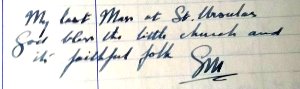
He served in several parishes in the London area before spending just ovwe five years in Berne. (An article in the diocesan Church Magazine reported on the last year of his ministry.) In 1913, he moved to the chaplaincy at Algiers.
Gilbert Sissons was chaplain at the time the present church was built. He was appointed at the end of 1904, and stayed for a little over two years.
During this time, his mother, Jane Thompson Sissons, who would have been aged about 65, attended Professor Kocher's clinic, presumably for a goitre operation. Through her contact with Mrs Castleman, the money which was being appealed for to build the new church at Jubiläumsplatz was eventually donated.
He subsequently moved to St John's, Menton, where he stayed from 1907 until 1916. He next moved to All Saints', Rome for four years, and became Rural Dean for Italy and Malta, as well as the French Riviera. In 1921 he moved to Venice, in 1922 to Alassio, and from 1932 to his retirement in 1934 he was at Bordighera.
In 1882 he became chaplain of the English church in Xeres, Spain, moving at the end of the next year to Bologna, and then in 1887 for a short time to Berne. He was the first chaplain appointed after the Society for the Propagation of the Gospel (SPG) had taken over the patronage from the Colonial and Continental Church Society (CCCS).
After five years in Gibraltar, he became chaplain in Berne from 1890 to 1893.
He next spent a year at Honeychurch in Devon, and then returned to the continent, serving at Dinant from 1894 to 1897, and then in Capri.
In 1897 SPG appointed him chaplain in Berne, and he served there for six years. He left on 13 April 1903. In 1905 he moved to Boulogne, France.
The Clergy List for 1852 lists him at Berne. Crockford's Directory for 1860 lists him as "Chaplain to HBM Embassy at Berne". After leaving Berne, he moved to Sheffield. He retired to Hampshire, and later to Kent, where he died in 1889.
He worked with the Mission to Seamen in London and Antwerp, and served as chaplain to the forces during the First World War. He returned to Switzerland in 1919, when he was appointed chaplain in Davos. He was there for three years before returning to Britain, where he ministered in Perth from 1922 for five years, Appledore, Kent from 1927 and then at Sandwich from 1931 until 1946.
On 1 June 1946, at the age of 67, he replaced George Moore as chaplain in Berne. He served the chaplaincies of Berne, Neuchatel and Basle, taking an evening service in Basle every second Sunday. In 1949, he was appointed Rural Dean of Switzerland. He was particularly friendly with Bishop A. Stephen Neill, who had been appointed delegate of the Archbishop of Canterbury to the World Council of Churches in Geneva in 1947.
In spring 1952 Markus Vischer left Berne and moved to Basle, where he continued to work until his retirement in 1954 at the age of 75.
He visited Berne shortly after his consecration, and was involved in many of the developments there, including the project to take over the Antonierkirche in Postgasse. His Twenty Years of Continental Work and Travel relate several of his experiences, and record his visits to Berne in 1886, 1889, 1895 and 1901. It was he who consecrated the newly-built church of St Ursula on 20 September 1906.
He served until March 1911.
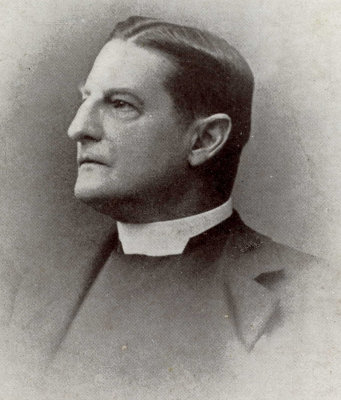
Bassell Winter contributed the column Currente Calamo to the Anglican Church Magazine, giving several insights into life in Berne during the interwar years. He died on 15 November 1935.